
A Farmer’s Dilemma
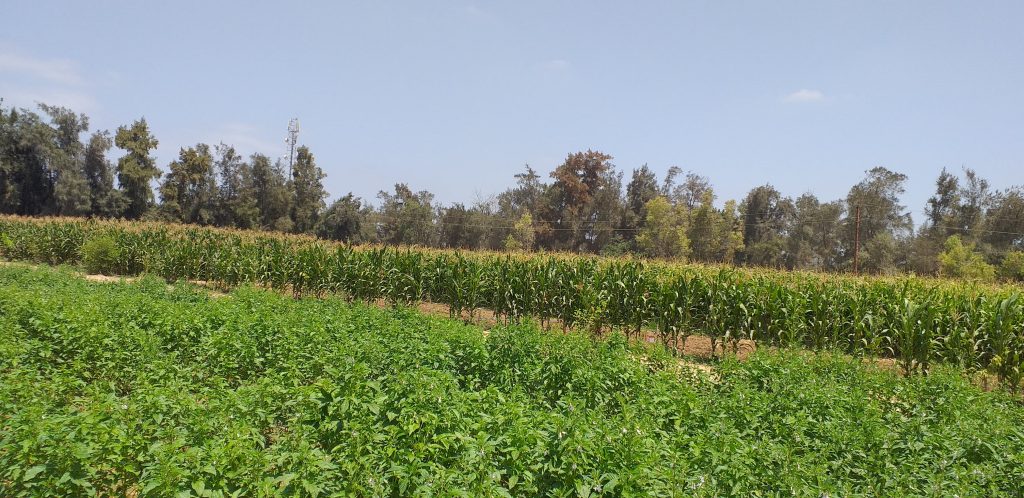
One morning in early July, a farmer in a semi-arid region, stood in his cornfield, staring at the yellowing tips of the leaves. He had applied water last week, just like he always did. So why were his crops stressed? His neighbor Ali, an agricultural engineer, looked at him and said, “it’s not just about watering every week; it’s about how much water your crop really needs. You need to calculate the crop water requirement, or ETc.” This article will help you understand ETc in a simple and practical way, just like Ali explained it to the farmer. Whether you’re a farmer, an engineer, or a student, you’ll learn how to calculate crop water needs, how to adjust for rainfall and irrigation systems, and how to deal with different soils and salt levels.
What is ETc?
ETc stands for Crop Evapotranspiration, that’s the amount of water a crop uses through evaporation (from the soil) and transpiration (through the plant leaves). This is how much water your crop needs to grow healthy and strong.
But ETc isn’t something you just guess. It’s based on two key things:
- ETo: Reference Evapotranspiration
- Kc: Crop Coefficient
The equation is simple:
ETc = ETo × Kc
What is ETo?
ETo is the amount of water lost from a reference grass field under ideal conditions. It represents how “thirsty” the atmosphere is in a certain location.
Where can I get ETo?
- FAO’s CLIMWAT or CROPWAT tools (Free)
- WaPOR (by FAO): https://wapor.apps.fao.org/home
- National Meteorological Services
- Local weather stations or agro-climatic apps
ETo is affected by sunlight, temperature, wind, and humidity. Hot, dry, and windy weather increases ETo.
What is Kc?
Kc is the crop factor. It changes based on the crop type and its growth stage. Young crops use less water; mature, leafy ones use more.
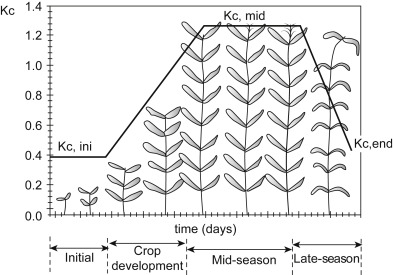
For example, let’s look at maize (corn):
| Growth Stage | Days (Approx.) | Kc Value |
| Initial | 0–20 | 0.30 |
| Crop Development | 21–45 | 0.70 |
| Mid-Season (Peak) | 46–80 | 1.15 |
| Late Season | 81–100 | 0.60 |
Source: FAO Irrigation and Drainage Paper 56 (Allen et al., 1998)
Example: Calculating ETc for Maize
Let’s say you’re growing maize, and today it’s in the mid-season stage. Your weather station shows the ETo is 6 mm/day.
Using the formula:
ETc = 6 mm/day × 1.15 (Kc) = 6.9 mm/day
That’s how much water the maize needs each day during this period.
But Wait, What About Rainfall?
Not all rainfall helps the crop. Some is lost to runoff or deep percolation. That’s why we calculate Effective Rainfall (Pe).
Let’s say your field received 8 mm of rain, but only 5 mm was stored in the root zone.
Then your Net ETc becomes:
Net ETc = ETc – Pe = 6.9 mm – 5 mm = 1.9 mm
That’s the water you still need to add using irrigation.
Irrigation System Efficiency
No irrigation system is perfect. Water can be lost through leaks, wind drift, or evaporation. So we adjust for efficiency (Ef):
| System | Efficiency (%) |
| Surface/Furrow | 50–60% |
| Sprinkler | 70–85% |
| Drip | 90–95% |
To find how much water to apply:
Irrigation Requirement (IR) = Net ETc ÷ Ef
If Net ETc = 1.9 mm and you’re using a sprinkler (80%):
IR = 1.9 mm ÷ 0.8 = 2.375 mm That’s the gross water amount needed.
Soil Type and Irrigation
Different soils store water differently:
| Soil Type | Water Holding Capacity | Drainage |
| Sand | Low | Fast draining |
| Loam | Moderate | Balanced |
| Clay | High | Slow draining |
Sandy soils need more frequent but smaller irrigation. Clay soils can hold more water, but be careful to not water too much, as roots may suffocate.
What About Salinity?
In salty soils or when using saline water, you must add extra water to leach the salts below the root zone. This is called the Leaching Fraction (LF).
Total Irrigation = IR ÷ (1 – LF)
Example: If your required irrigation is 2.375 mm and LF is 15% (0.15):
Total = 2.375 ÷ (1 – 0.15) = 2.79 mm
That’s the total water needed, including for leaching.
Conclusion
Irrigation isn’t just about pouring water on crops. It’s a science of precision, knowing how much water the crop needs (ETc), adjusting for the weather (ETo), the crop stage (Kc), rainfall, soil type, irrigation system, and even salinity.
Smart irrigation means saving water, growing healthier crops, and reducing costs.
So next time you pick up that irrigation hose or switch on the pump, ask yourself:
Are you giving your crop what it really needs?
Very good
Thank you for your feedback, Mahmoud.